Pour the bread crumbs into a bowl and add the boiling water.
Let stand 10 minutes. Mound the flour on a work surface. Using a wooden spoon, make a well in the mound that looks like a volcano crater.
Add the eggs, 10 tablespoons water, and soaked bread crumbs to the well. Blend them together with a wooden spoon. The gradually stir in the flour by making shallow scrapings along the walls of the well and incorporating the flour into the liquids. Use a pastry scraper to catch any liquids that might escape from the flour crater. Once the mixture has become a rough dough, knead it by hand 10 minutes, or until elastic. It should be quite stiff and not very sticky. Wrap the dough in plastic wrap and let it stand at room temperature 30 minutes.
To shape the pisarei: These little pasta curls are shaped by taking a pea-sized piece of dough, pressing it with the tip of the thumb, then pulling the thumb back and up in a quick motion. The dough thins and curls, forming a C-shape in profile. After you've made several pieces, a rhythm will develop and shaping the pisarei will become automatic. Have handy several large flat baskets lined with kitchen towels for drying the pasta. Take 1/4 of the dough (keep the rest wrapped in plastic wrap) and divide it into 10 pieces.
Roll out each piece with the flat of your palm to form a long cord 1/4 to 1/2-inch in diameter. Keep the cords covered with plastic wrap. Take out 1 cord and cut it into pea-sized pieces. Use the tip of you thumb to curl each piece into the work surface and then pull back and up. It is a flicking motion.
Spread the pieces on the baskets without letting them touch.
Place the beans in a large pot and add enough cold water to cover by about 3 inches.
Add sage leaves and rosemary. Cover and bring to a very slow bubble over medium heat. Adjust the heat so that the water bubbles slowly. Cook, covered, 1 hour, or until the beans are just tender enough to eat but not at all mushy.
Drain the beans in a colander, and return them to the pot.
Making the tomato sauce: While the beans are cooking, heat the olive oil and pancetta fat in a heavy 4-quart saucepan over medium-high heat.
Add the onion and parsley.
Saute the onions to a rich golden brown, about 10 minutes.
Add the garlic, basil and tomato paste, and cook about 30 seconds.
Add the tomatoes and their liquid, breaking them up as they go into the pan. Bring to a lively bubble and cook, uncovered, 5 minutes. Season with salt and pepper.
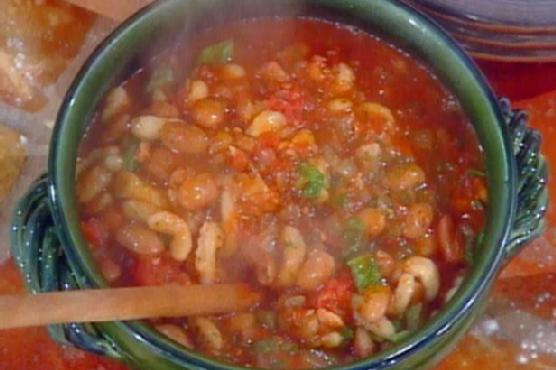
Place the beans in a large pot with the tomato sauce and the 1 cup water, and bring the bean/tomato mixture to a gentle bubble. The mixture should bubble very slowly. Partially cover and cook 1/2 hour, until the beans are very tender (but not falling apart), and have the consistency of a thick soup. Stir frequently to check for sticking.
Add more water if the mixture threatens to burn.
Place 6 quarts water to a boil and add 2 tablespoons salt. Drop in the pisarei and boil 5 to 6 minutes, until they float and are light.
Drain in a colander.
Pour the beans into the heated serving bowl and fold the two together, taking care not to break up the pasta.
Sprinkle with a few spoonfuls of the cheese, and serve. Pass the rest of the Parmigiano-Reggiano separately.